
I’ve seen used car managers spend a lot of time on Facebook Marketplace because they need more inventory. Finding a car is only the beginning. Then they have to figure out whether the listing is worth pursuing, contact the seller, and keep track of what happens.
A car looks promising. The price works. The mileage works. Then, halfway through the description, there’s the rebuilt title.
Or the store wants for-sale-by-owner (FSBO) vehicles, and a listing under someone’s name turns out to be a car from a small lot.
That’s the part of vehicle acquisition I wanted to work on: all the sorting, checking, and follow-up that happens before a buyer gets to make a buying decision.
We’ve built agents around three parts of that work: sourcing, outreach, and documentation. The goal is to give the used car manager a prioritized list of vehicles worth a closer look, with the next step already prepared.
1. Find the listings worth pursuing
We start with what the store actually wants to buy: search radius, model years, mileage, price range, vehicle types, and title requirements. If the buyer wants private-party vehicles only, that becomes part of the screen too.
The agent gathers and reviews listings against those preferences. It looks at the description and available photos, flags reasons to pass, and keeps uncertain listings separate from the ones that are ready for a buyer’s review.
I’ve found that the seller check deserves its own attention. A person’s name on a listing doesn’t establish that it’s a private-party sale. Dealer language in the description, business branding, or a stock number can change how that listing should be handled.
A real example: One 2016 Honda Accord appeared under an individual seller profile. Its expanded listing description said “Sold by Dealer.” That’s enough to exclude it from a private-party-only search, even though the profile itself looks personal.
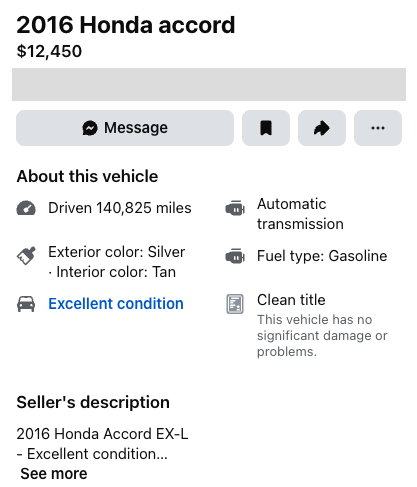
I want the buyer to see why a vehicle made the list. “No red flags found in the listing” is useful, but it still leaves title, ownership, condition, and availability to confirm.
| Vehicle | Asking price | What the buyer sees |
|---|---|---|
| 2021 Nissan Rogue SV53,000 miles | $13,900 | Initial screen passed. Directional price comparison available. Confirm condition and ownership. |
| 2018 Hyundai Elantra Value Edition80,670 miles | $10,500 | Only $150 below the recorded directional reference price, before any acquisition costs. |
| 2018 Ford F-250 FX487,000 miles | $37,900 | Initial screen passed. Valuation pending; no margin estimate yet. |
A low asking price is only part of the math
The DealerClaw agent also compares the asking price with a directional market reference. That gives the buyer a starting point for deciding whether a vehicle deserves more research.
One example in the report was a 2021 Nissan Rogue SV listed at $13,900. The directional Kelley Blue Book Fair Purchase Price recorded on September 15, 2026 was $18,360. That’s a $4,460 gap—but the store doesn’t get to keep all of it.
Recon, transportation, and fees still have to come out. So does whatever reserve the buyer wants for the things an inspection might uncover.
2021 Nissan Rogue SV · Example buying math
- Recorded directional reference price
- $18,360
- Asking price
- − $13,900
- Reconditioning allowance
- − $1,800
- Transportation
- − $350
- Other acquisition fees
- − $450
- Contingency reserve
- − $500
- Remaining spread under these assumptions
- $1,360
With the store’s own cost assumptions and target margin, the agent can work backward to a buying range. If the valuation is missing or the comparable vehicles aren’t a good match, I want that visible instead of a confident-looking profit number.
2. Prepare the seller outreach
Once a vehicle looks worth pursuing, somebody still has to start the conversation.
For the Facebook side of this workflow, we’ve set up Muse agents to work in Facebook and draft personalized outreach for the used car manager, buyer, or acquisition manager.
The draft can use what’s already in the listing and focus on the missing information. If the seller has already listed the mileage, asking for it again wastes a message. If title status is unclear, that’s a better place to start.
The point is to put a useful conversation in front of the buyer, with enough context to move it forward.
3. Keep the conversation and next step together
The extra step of documenting every conversation is easy to skip. I’ve seen how quickly that turns into someone remembering a car they messaged, but not remembering where the conversation ended.
We’ve designed the Muse workflow to log the communication alongside the vehicle: who owns the follow-up, what was offered, what the seller said, and what needs to happen next. The buyer shouldn’t have to recreate the conversation in a separate tracker.
That history also gives the agent a reason to check back. Maybe the seller never replied. Maybe they declined an offer, but the vehicle is still listed several weeks later.
Example next step: Seller declined the first offer. Check whether the vehicle is still available in two weeks, then prepare a follow-up for the buyer to review.
A seller may be more open to a conversation after the car has sat for a while. It’s a reason to revisit the listing, not an assumption that they’ll accept less. If the car sells or the seller asks us to stop, the follow-up stops too.
That’s where I see the time going back to the buyer: evaluating the car, talking with the seller, negotiating, and deciding what belongs on the lot.
The next step: source the cars people already want
The part I’m most interested in next is connecting acquisition to the demand the store already has.
Say a used 2024 Toyota Camry gets 29 leads and sells to one of those shoppers. There may be 28 other people who were interested in a similar car.
I wouldn’t treat that as 28 guaranteed buyers. Some leads may be duplicates, some people may have bought elsewhere, and some may want something different now. But it’s a useful place to look.
With the store’s approved CRM and inventory access, an agent could identify that opportunity, check whether comparable cars are already in stock, and search approved auction sources when there’s a gap.
Now the acquisition list starts with vehicles the store has a reason to want. That’s the next phase I want to connect to the sourcing work.
Common questions
Vehicle acquisition FAQ
How can AI help a dealership acquire used vehicles?
An agent can review listings against the store’s buying criteria, prioritize vehicles, prepare seller outreach, and keep communication and follow-up organized. The buyer still evaluates the vehicle, approves offers, and makes the purchase decision.
Can the agent filter rebuilt-title and dealer listings?
It can flag disclosed rebuilt or salvage titles and commercial-sale signals in the listing’s text and photos. Missing or ambiguous evidence stays unresolved. A listing screen does not independently verify title, seller identity, or ownership.
Does a price gap mean the vehicle will be profitable?
No. A directional market reference is a starting point. The buyer needs to account for recon, transport, fees, selling costs, and the vehicle’s actual condition. A forecast also depends on the eventual resale price.
Does the agent send offers or buy vehicles on its own?
The workflow described here prepares messages and follow-up for buyer review. The dealership controls seller contact, offers, appointments, and purchase decisions.
Can sourcing be based on CRM demand?
That is the next-step workflow described here: review remaining shopper interest, compare it with current inventory, and source similar vehicles through approved channels when there is a gap. The Camry example is hypothetical.
The sourcing examples are anonymized records. The cost allowances, outreach draft, follow-up scenario, and Camry demand example illustrate the workflow; they are not documented acquisition results.